Shoreline Restoration & Riprap in Minnesota
Stop shoreline erosion and protect your lakeshore with properly sized natural rock, planned around Minnesota DNR rules and the way waves and ice move on your water.
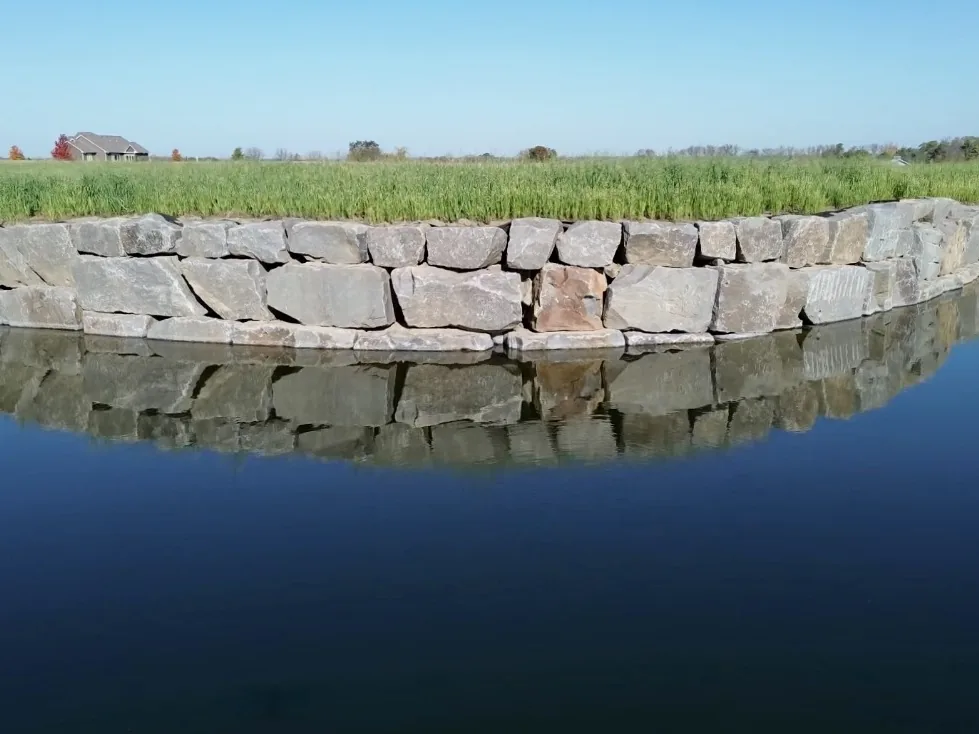
Waves, ice, and runoff wear away unprotected banks. Riprap and shoreline restoration put a stable edge back between your yard and the water.
Repair Eroding Shorelines Before They Get Worse
A shoreline that is losing ground rarely fixes itself. Undercut banks, exposed tree roots, slumping soil, and a waterline that creeps closer to the lawn each year are signs that waves, ice push, or runoff are carrying the bank away.
Riprap is a layer of natural rock placed on a prepared slope at the water's edge. Set over a filter layer of gravel or fabric and sized for the wave and ice action on your water, it absorbs that energy so the soil behind it stays put.
Retaining Walls GraniteCo plans each shoreline around the bank, the water, and the property above it. Where the yard itself needs grade support, we can pair the shoreline work with a boulder retaining wall set back from the water, along with proper drainage so runoff from the yard does not undo the work.
What a Lasting Riprap Shoreline Needs
A Real Erosion Problem
Riprap belongs where a shoreline is actively eroding or needs restoring, not as decoration on a stable, naturally vegetated bank.
A Filter Layer Underneath
Crushed rock, gravel, or filter fabric under the stone keeps soil from washing out through the gaps.
Rock Sized for the Water
Natural rock, generally 6 to 30 inches, sized for the waves, current, and ice on your lake or river. Concrete rubble is not allowed.
A Gentle, Stable Slope
A finished slope no steeper than 3:1 lets the rock absorb wave energy instead of being knocked loose.
Following the Natural Shoreline
The rock should follow the existing shore alignment and stay close to the ordinary high water level without blocking navigation or flow.
Plants Where Possible
Native plantings within and above the rock help hold soil, improve habitat, and give the shoreline a more natural look.
Working Within DNR and Local Rules
In Minnesota, the DNR regulates work below the ordinary high water level of public waters, and your city or county regulates work above it. Riprap can go in without a DNR public waters work permit only when every DNR condition is met, including limits on rock size, slope, how far the rock extends into the water, and total shoreline length.
Stacked boulders at the water's edge are treated as a retaining wall, not riprap, and need a DNR permit. Local permits may also be required when grading moves more than 10 cubic yards of material or when the shoreline is in a mapped floodplain.
We review these requirements for your specific shoreline before work begins, so the project is designed to be built once and built right.
Questions About Shoreline Restoration
Do I need a DNR permit for riprap?+
Sometimes. The Minnesota DNR lets riprap go in without a public waters work permit only when every one of its conditions is met, including a demonstrated erosion problem, natural rock roughly 6 to 30 inches in size over a filter layer, a finished slope no steeper than 3:1, no more than 6 feet past the ordinary high water level, and no more than 200 feet of lake or wetland shoreline. If any condition is not met, a permit is required, and local permits may still apply. We review these requirements for your shoreline before work begins.
Can you build a boulder wall right at the water's edge?+
The DNR treats one or more rows of stacked boulders as a retaining wall rather than riprap, and a retaining wall in public waters requires a DNR permit. In many cases a riprap slope at the shoreline, with any retaining wall set back above the ordinary high water level, is the more practical and permittable approach.
Is riprap maintenance-free?+
No. Ice can still push and shift rock, and storms or high water can move individual stones. Walking the shoreline each spring after ice-out and resetting displaced rock early keeps small problems from turning into new erosion.
What affects the cost of shoreline restoration?+
Shoreline length, bank height, rock size and quantity, equipment access to the shore, the amount of grading needed, plantings, and permit requirements all affect the price. A site visit lets us define the scope and quote the actual project.
Can riprap be combined with native plantings?+
Yes. The DNR encourages natural shoreline approaches, and planting native vegetation within and above the rock can help hold soil, improve habitat, and soften the look of the shoreline.
Do you work on lakes outside the Twin Cities?+
Yes. We take on shoreline projects on lakes and rivers across Minnesota from our office in Woodbury. See our service area or call to confirm scheduling for your property.
Stop the Erosion Before Next Season
Tell Retaining Walls GraniteCo where your property is and what you are seeing along the water. We will review the shoreline, the rules that apply, and a practical plan to stabilize it.